
Photo source: Andre Vashist. Retreat in Summer 2026.
Last weekend we came together for a retreat to explore the practical, cultural, and ecological foundations of building a local ecovillage in the London, Ontario region. Hosted in a place that has been stewarded for decades in harmony with nature, the retreat brought together people at different stages of life, with different experiences, skills, expectations, and visions for what community living might look like.

Photo source: The Living Centre. Aerial photo.
One of the most interesting things that emerged during the weekend was just how diverse our visions and levels of readiness were. For some, joining an ecovillage could happen right now; for others, it might be a possibility many years into the future. Some imagined themselves as residents, while others were more interested in being advocates or demonstrating that different ways of living are possible. There were differences in our preferences for low-tech or high-tech living, the balance between private and shared spaces, and even everyday choices such as food; from vegan to what one participant jokingly described as “carnivore.” Just as important were differences in our comfort levels around living alongside people whose choices and lifestyles may be very different from our own.
Yet beneath these differences was something remarkably consistent: a shared desire to explore ways of living together and to reshape our relationship with the land in a more harmonious and sustainable way.
From a shared idea to a shared future
The Living Village initiative is part of Journeyland and it’s still emerging. That makes this an especially interesting moment to bring participatory futures into the process.
Future thinking is not about predicting what will happen. In fact, one of its most important premises is that there is no single future waiting for us to discover. There are multiple possible futures, and our choices, relationships, and actions help shape which ones become possible.
As futurist Alvin Tofler puts it, “In dealing with the future, it is far more important to be imaginative than to be right.”
This is particularly relevant to an emerging ecovillage. Before deciding what to build, where to build it, or how to organize it, there is value in collectively asking:
“What kind of future are we trying to create?”
What would a village for 20 people look like? Where would it be located? What would we share? What would remain private? How would we eat, work, travel, make decisions, raise children, welcome newcomers, resolve conflicts, and care for the land? What technologies would we embrace and which would we deliberately leave behind?

Photo source: The Project. Ecovillage example.
These questions are not simply about designing a physical development. They are questions about relationships, values, culture, governance, and ways of life.
And imagining these possibilities can be both practical and liberating.
Around the world, communities have already demonstrated that alternatives to conventional housing and patterns of consumption are possible. Some of the people present were able to witness that transformation. Costa Rica, for example, had very few ecovillages several decades ago and now has a growing network of communities experimenting with different approaches to ecological living. During our retreat, we also had the opportunity to learn from Helen Zuman of Earthaven Ecovillage, who shared experiences from one of these real-world decades-long experiments in community living. Her stories brought abstract questions about governance, money, relationships, work, and decision-making into the realm of lived experience.
These stories matter because they expand our sense of what is possible. They remind us that we do not have to invent everything from scratch, and that there is much to learn from both the successes and struggles of communities that have gone before us.
Demonstration is more powerful than education
Perhaps one of the most important insights from the retreat came from one of our hosts: demonstration is more important than education.
For one weekend, we did not simply talk about community. We practiced it.
We shared space, meals, chores, conversations, ideas, frustrations, laughter, and dreams. We experienced, even if only temporarily, what it means to negotiate shared spaces and responsibilities with other people. We discovered similarities, but also differences that might become important if we were to live together for years rather than days.
That experience is itself a form of future-making.
It allows us to move beyond imagining an ecovillage as a physical place and begin experimenting with the social relationships that would make such a place possible.
“I am because you are”
One participant shared his experience growing up in Africa and talked about the idea of Ubuntu: I am because you are.
There are many interpretations of Ubuntu, but one particularly relevant to this conversation is the recognition that we are not entirely independent beings. Our lives, identities, capacities, and wellbeing are shaped and enabled through our relationships with others.
This resonates with the familiar idea that it takes a village to raise a child. But perhaps we can take the idea further: it may also take a village to care for the land.
Individualism makes some of the challenges of ecological living difficult, if not impossible, to address alone. Sharing resources, knowledge, labour, skills, responsibilities, and decision-making can create capacities that individuals and nuclear families cannot easily develop on their own.
Ubuntu can therefore be understood not only as a principle for living together in the present, but also as a way of thinking about the future. What happens when we shift our focus from planning primarily for our own individual or nuclear-family futures toward creating shared futures?
Why participatory futures matter
This is where participatory futures can offer more than a collection of interesting activities. It can become an ongoing practice for the group.
Future thinking can help us:
- Expose assumptions and things we currently take for granted.
- Expand the range of possibilities we consider.
- Imagine alternatives beyond today’s constraints.
- Develop greater flexibility in responding to change.
- Build empathy and emotional connections with possible futures.
- Strengthen our sense of agency, the recognition that our actions can influence what comes next.
Making that process participatory adds another dimension. Bringing different perspectives into the process can help identify shared values and common goals, strengthen relationships, expand networks, and build commitment to collective action.
The process does not need to produce one definitive vision. In fact, it may be more valuable to deliberately develop several possible futures.
The group could use tools such as future scenarios, visioning exercises, social simulations, “future me” activities, and backcasting to explore different possibilities. For example, participants might imagine visiting the ecovillage 20 years from now. What do they see? Who lives there? What happens on a typical day? What has worked particularly well? What unexpected challenges emerged? What decisions made decades earlier turned out to be important?

Photo source: The Project. Ecovillage example.
From there, the group can work backwards: If this is a future we want, what would need to happen five, ten, or fifteen years from now? And what could we begin doing today?
Another example is building imaginary prototypes or future scenarios and experiment with people’s responses and reactions to it. An exercise that can help bring values and assumptions to the fore, harness synergies, and address potential challenges early on.
The future is not a destination
Building an ecovillage is likely to take time. Circumstances will change. People will join and leave. Resources will fluctuate. Regulations, technologies, economic conditions, relationships, and ecological realities will all evolve.
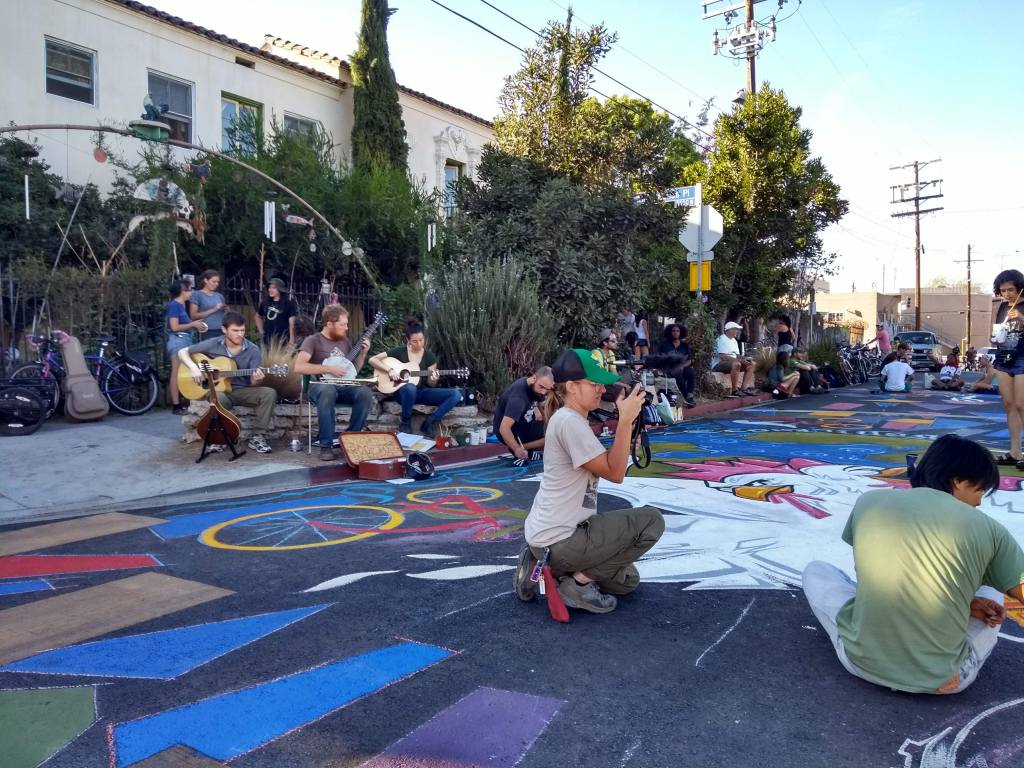
Photo source: Luis Patricio. Visit to LA Ecovillage
A tangible long-term goal can be extremely valuable. It can provide direction, help coordinate efforts, and galvanize action. But there is also a danger in becoming attached to one particular solution.
Perhaps the group will eventually discover that the original vision is not feasible or that something better has emerged.
A group with a participatory futures mindset may be better prepared for that possibility. Rather than being committed to one specific future, its members can remain committed to the values underlying that future. They can recognize that their shared aspirations: community, ecological responsibility, connection to land, mutual support, and meaningful relationships; might be achieved in more than one way.
This distinction is important: we can be committed to a direction without being committed to a single destination.
Participatory futures can therefore become a kind of collective muscle. The more regularly a group imagines, discusses, experiments with, and reflects on possible futures, the more capable it becomes of recognizing change and responding creatively to it.
From imagining to becoming
Perhaps the most exciting possibility is that the process of imagining the future is already part of creating it.
When we gather to imagine how we might live together, we are not simply designing a future physical space. We are beginning to practice the relationships, values, conversations, and forms of collaboration that such a community would require. The retreat gave us a small taste of that possibility.

Photo source: Scan Magazine. Co-living in Scandinavia.
We came together with different expectations, different levels of readiness, and different ideas about what an ecovillage could be. We left with a greater appreciation of both our diversity and the values we share.
The next step may not be to agree immediately on exactly what the future village should look like. Instead, it may be to keep asking better questions, to imagine multiple futures, to learn from communities already experimenting with alternatives, and to create opportunities to practice living together.
After all, the future of the village may begin long before the village itself exists.

