A vast number of urban transportation studies investigating mobility justice issues focus on home-to-work trips. Even the recent INTERACT report (Practices and Inspirations for Sustainable Transportation Equity) states that nearly a million Canadians experience transport poverty, based on an article that highlights accessibility to employment opportunities and income levels in the eight largest cities in Canada.
In the article Conceptualizing Mobility Inequality we showed that mobility justice involves many other dimensions, affecting a much higher number of people. The Unseen Commuters book also demonstrates the intersectional nature of mobility justice.
Besides the challenge of collecting and analyzing data in all possible dimensions, there are different reasons to choose commuting to work as the metric for accessibility. It’s a regular trip to a large percentage of our society with somewhat predictable patterns in terms of space/time and considerable economic implications.
This is a great starting point, however adopting home-to-work trips as the main, or sometimes the only, measure for mobility poverty has a few limitations. This approach:
- Leaves out of the equation everybody who is not working (e.g.: children & teens, retired, unemployed, people doing unpaid/care work).
- Ignores/downplays other trips (e.g.: health, education, job searching, shopping, care, socializing, physical activities, recreation).
- Fails to acknowledge the growing trends outside the 9-5 jobs (e.g.: work from home, shift work, gig economy, flexible workdays and hours).
- Assigns value to work above anything else (e.g.: belonging, mental health, happiness).
Jarrett Walker, author of Human Transit, defines peaking as a significant increase in trips during a period of the day generally because of school and/or office jobs. According to Walker, peaking is decreasing due to changes in societal norms.
Overall, the post-COVID world has far less peaking of demand. For most transit authorities, that is the silver lining of the post-COVID ridership loss, because peaking is very expensive. – Jarrett Walker
Mobility Justice Beyond Commuting to Work
We only care about what we measure. By focusing research and tracking on commuter travel, we prioritize services for home-to-work trips during specific hours that are, in fact, trending down on the demand. Decisions like those have very real implications for many individuals experiencing mobility injustice. For example, public transit routes, frequency and service hours can be planned to connect people to jobs. This might coincide with other needs, but if we are not measuring or planning to fulfill those other needs, inevitably they will be undeserved.
Here in Canada, summer officially started last week. For that reason, trips taken for recreation are front of mind for many of us right now. So let’s focus on that specific type of non-work related trip. That include things like camping, going to the beach, attending concerts and festivals.
Many of those happen during weekends and/or evenings where transportation options can be very limited and even non-existent. Remember peaking? Yes, mobility options are centered around weekdays and “working hours”.
Is Accessibility to Recreation Important?
Here in London Ontario, we are “relatively” close to the Great Lakes and other amenities (some 40km to Port Stanley Beach or St Mary’s Quarry; and about 75km to Grand Bend Beach, Pinery Provincial Park or Ipperwash Beach). Those are very popular summer activities with a massive capacity while also being free or very low-cost. Great options for families who can’t afford hotels, resorts, expensive summer camps or international trips.
The benefits of outdoor activities and natural spaces are well documented. They have a significant influence on many of our basic human needs including emotional development, physical health, quality of sleep, belonging, academic achievement, happiness and many others (Hutton, 2019; Nguyen et al., 2021, Martin et al.,2020).

Ensuring affordable and convenient transportation options to all those places is not just a nice-to-have given how outdoor summer activities (or the lack of access to them) can affect our lives. Additionally, outdoor public spaces can easily replace other more costly and complex alternatives to provide individuals and families with the same benefits such as summer camp programs and facilities.
Unfortunately, not everybody has easy access to those amenities (beaches and parks). You may have noticed that when I mentioned some destinations a few paragraphs earlier, I used kilometres when generally we measure trips in time instead. When we read something like “Approximately 45 minutes from London – history, charm and of course, sandy beaches await… ,” we need to ask: For whom?
Different modes and different people don’t take the same amount of time. Using the time it takes to drive as the standard measurement, is one of the many ways that a car-centric mindset shapes our lives and excludes people.
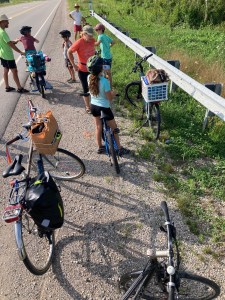
If you don’t have access to a car, you don’t really have other convenient options because they won’t be “approximately 45 minutes from London.” For example, you can bike to Port Stanley. Yes it’s doable even with kids! It might take over three hours one way and obviously not realistic on a larger scale. Another example is the Huron Shores Area Transit that offers a limited daily service between London and Grand Bend.
Beyond that, options are really limited. Consider taking your family to a place like Otter River Farms for the weekend, driving is probably your only option. If you are renting a car, it will cost you more to get there and back than all the other expenses combined including accommodations, food, outings and some small incidentals.
So Near And Yet So Far
I focused on out of town trips because it is easier to demonstrate the inaccessibility of those places. But even right here in the City of London, there are hard to reach local attractions. For example:
- Fanshawe Pioneer Village – a living history museum with regular outdoor games, activities and occasional special events.
- Fanshawe Conservation Area – a destination for picnics, camping, hiking and fishing
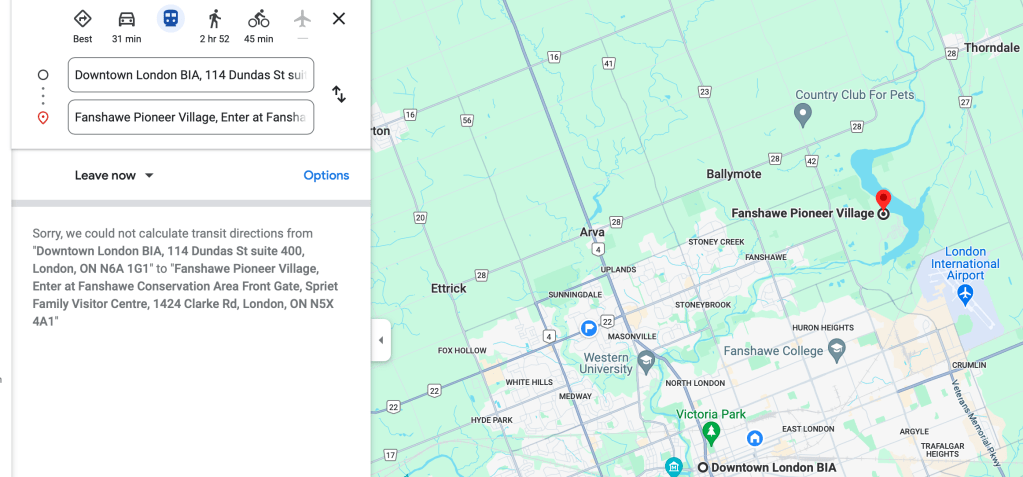
In both cases, there is no public transit service to get there. Nevertheless, according to the Fanshawe Conservation Area website, it “has so much to offer and we are only minutes away from London, Ontario.” (driving time again!)
So What Is Possible?

Projects like the Banff Railway Lands Area Redevelopment Plan can be inspiring. Its goals include “reduce car traffic”, provide “convenient transit options” and “create a compact, walkable and bikeable destination.”
One might argue that this kind of solution is only possible on a modern top notch park. But we need to remember that more than a hundred years ago we already had a public and electric transit system that transported more than 1,200 people per day between London and Port Stanley (London Freedom Convoy).
How would our transportation system look like today if we adopted a mobility justice lens and consider access to summer activities as a basic need?
 Luis Patricio
Gave my car -centric head a good shake!
Inspirational, and actionable.
Thanks, Luis.
LikeLiked by 1 person
Thanks Pam. Glad to hear it added a new perspective for you.
LikeLike
I would love to see better train service to get from one urban area to another – much preferable to driving on the 401. For trips to beaches, conservation areas, or campgrounds, trains or comprehensive rural bus routes seem like a long shot. One option is to be part of a car-sharing service. It still costs money, but much less than owning and maintaining your own car. Hopefully car sharing services will continue to grow since they allow people to live “car free” except for some occasions when a car can be very useful.
LikeLiked by 1 person
Yes Brian, you are right. A high quality rail service would also attract many people who don’t face mobility poverty. I think many other possibilities would become available once our priority is equity and we realize how valuable culture, sport, and social life are.
LikeLike
thanks for bringing attention to this basic mobility need! As your partner and as a couple who choose to live car-free, we really feel the lack of access to the beaches and places like Fanshawe Park in the summer 🙁 I wonder how many Londoners have never even been to one of the beaches nearby?! Probably a much higher number than most would expect!
LikeLike
Thank you for drawing attention to this basic mobility need – to have access to beaches and natural spaces outside of the city! While we may feel brave enough to bike to Port Stanley, many do not. I wonder how many Londoners have never been to the beach? Probably a shocking number to those with cars!
LikeLike
I really enjoyed your piece, Luis! It made me think about mobility justice in a different way. I like how you highlighted transportation revolves around the 9-5 work week and little is provided outside of that.
LikeLiked by 1 person
Thank you Margaret. This is just one of the many ways that transportation systems impact people’s lives. It’s important to look at how we design, plan, fund, prioritize and talk about transport with a Mobility Justice lens.
LikeLike