We are back to school, it’s a chilly and rainy Tuesday morning in late September and they are there. It could have been a scorching morning in June or a freezing snowy one in January. They would have been there no matter what. The familiar and friendly face of the school crossing guard (SCG), helping our children get safe to school and back home.
A fixture in every Canadian community. According to the Government of Canada, there were 120,700 SCG jobs in 2021. Our children are, literally, our future and the SCGs have a crucial role in keeping them safe and ensuring they can have equal access to education.
The very fact that they are present and essential in every community is a public testimony of our complete failure in urban planning. Think about it for a moment. We need SCGs because our roads are not designed for children to safely use in the most basic urban trip, primarily in their own neighbourhood.
A Predictable Urban Trip
Commuting from home to school is arguably the most common urban trip in Canada, and many other countries around the world. Destinations, routes, volume, dates and times of the day are, for the most part, predictable and consistent. This is also a heavily researched topic, particularly active school travel (Pang et al., 2017; Buttazzoni et al., 2018; Ji et al., 2022). Yet, we do not dare to allow our children to face that trip by themselves. And we have good reasons for that.
Even though children’s mortality as a result from traffic crashes have been in decline since 1975, they are still responsible for one in every four unintentional deaths in Canada. Montreal is an example of how dangerous school streets have become in North America. The average distance between a child road injury and a school is less than 500 meters.
Here in London Ontario, just a couple of months ago, a child was hit by a car and they are in critical care at the hospital. The 70km/h road near the school where the collision happened is a new development. To this day, we are still designing deadly roads. You can hear the school principal discussing this issue in episode one of the Wheels and Beyond podcast.
Right to Autonomy, Freedom and Safety
Is it really that absurd to imagine that kids should have the right to use the streets in their neighbourhood without worrying about getting hurt or killed? That our roads should be built in such a way that children have enough independence to leave their homes and go to school on their own (or really anywhere in their own neighbourhood) without needing someone to stand in the middle of the street with a whistle and a bright vest every single school day?
Makeshift Solutions
Along with the creation of SCGs, other measures included restricting or banning altogether walking and biking to school. Those measures to prevent the massacre address only the symptoms, not the root cause. As the statistics above show and it is obvious to anyone living in Canada, the risk and danger still exists and it is very pervasive. In every Canadian city we have heavy objects at high speeds incompatible with human life (a.k.a. cars & trucks) sharing spaces that are meant to be public and inclusive.
Solutions focused on symptoms usually fail to solve the problem and create additional ones.
For example, the decline in fatalities is not necessarily due to safer streets, we just don’t let our kids walk and bike to school anymore. The significant decrease in walking and biking to school from the 1960s to the present day is the direct inverse of the increase of obesity rates in children. This is by no means the sole explanation but it is certainly part of the equation. A study from the University of Cambridge with more than 2,000 children “found that walking or cycling to school is a strong predictor of obesity levels, a result which was consistent across neighbourhoods, ethnicities and socioeconomic backgrounds.”

Effective Solutions
Even though cars are a reality in most cities and over one million people die on the roads around the world every year, in some places, the responses were quite different.
In Amsterdam for example, instead of accommodating motor vehicles above everything else, there was a concerted effort to limit its usage. As a result, a high number of students bike to school.
In Tokyo, kids as young as six years-old face long commutes on trains on their own in the biggest city in the world.
In Oulu, even with harsh winters, safe streets also include appropriate infrastructure maintenance. And again, you can see children regularly biking to school.
Makeshift to Permanent
It’s time to imagine a different path in North America and there are many initiatives hard at work doing exactly that.
There are seasonal/temporary initiatives like the School Streets Program that started in Toronto. It creates a car-free environment in front of schools at the start and end of the school day to prioritize safe walking conditions for children, their caregivers and teachers. An initiative that has great potential for scaling up and wide, leading to more definite changes.
There are similar initiatives in many other places. A pilot program in British Columbia promotes active school travel by providing loaner bikes, creating walking maps, improving traffic routes, installing bike racks, running events to incentivize and train kids and families.
There are more permanent ones where street design is rebuilt with wide sidewalks and bike lanes. Surrounded by trees, benches and art. Intersections are raised at the sidewalk level, making it clear that people have priority and it is the car who is entering their space, not the other way around. There is an even application process in New York City to allow for a more participatory decision process and encourage their implementation.
All those different measures have a cumulative effect. Lower speed limits invite more people to walk, bike and roll. Inviting public spaces with benches, trees and wide sidewalks encourages slower driving. Confidence and social acceptance allow more people to adopt active school travel. That creates a powerful positive feedback loop.
And there is more coming, Green Communities Canada will be leading a four-year Canada-wide school street initiative. If you want to know more you can tune in the next Vélo Canada Bikes monthly call.
Possible Futures
Streets that are designed to be safe and inviting public spaces where anyone can access the places they need to go regardless of their age, gender, socioeconomic status, ethnicity or physical ability; whether they walk, roll, bike, bus or drive.
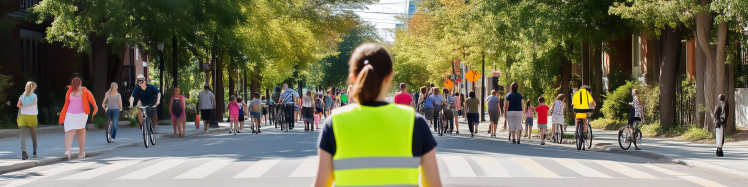
School Crossing Guard jobs have been reimagined. They now morphed into community activator jobs with their same friendly face and warm smile, they are there not to prevent deaths lurking in every intersection, but to build community and a thriving neighbourhood.
 Luis Patricio