Earlier this month we had another event to promote the recently published book: Unseen Commuters: Navigating Injustices in Urban Mobility.
The event was hosted at the London Bicycle Cafe during the opening night of the Bikes Are The Future Art Show by Hailey Tallman.

How It All Started
Unseen Commuters is a project related to Mobility Justice that I coordinated during my role as SDG Cities London program manager at Pillar Nonprofit Network.
The book was one of the final deliverables from a research partnership project called Vision Zero Hamilton Road that involved several community partners in London and the national initiative Mobilizing Justice. The project started as a response after a person driving a car killed Jibin Benoy in a traffic collision on September 2022.
As part of a program funded by the Government of Canada to advance the UN Sustainable Development Goals the project adopted a holistic approach. Due to its nature, the project quickly evolved from neighbourhood to city-wide and was looking at the intersection of urban mobility and several other social issues.
The project looked beyond road safety issues considering individuals also deprived of job prospects, healthcare, lacking access to fresh or any food, and possibly even being confined to one’s home, thus remaining invisible in conventional traffic assessments that influence urban mobility infrastructure projects. Or even families opting for environmentally friendly choices like reducing car usage, only to sacrifice convenience and freedom when it comes to accessing local amenities within the city.
About the Book
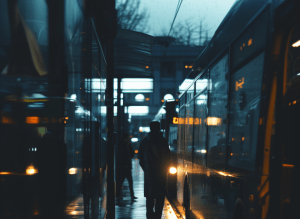
The extensive data collection in multiple stages and using different methods provided a rich picture of the mobility struggles that many of us are going through. The book was our response to the challenge of organizing and translating all that data into something meaningful and accessible to as many people as possible, decision makers and citizens alike.
The book contains eight stories with fictional characters, however, the facts in each story are very real. The fictional lives are a collage of real world occurrences. There is an additional ninth story about what London can be, a story about mobility wealth.
The book also includes some statistics to contextualize the scope of those issues. Lessons learned based on the many meeting with residents, experts and City of London staff. And some background on the two main frameworks that guided the project.
During the event, we had an opportunity to talk a little bit about the book and read two of the short stories. That was captured by Ben Durham from Defiant Sheep and you can watch it here:
How Urgent Is This Issue?
When we consider the percentage of the population with one or more intersectional identities that tend to experience mobility injustice, we realize that, in London alone with a population approaching half a million people, there are hundreds of thousands of people that might be facing mobility injustice in some way, shape or form. When those characteristics intersect, challenges are exponentially harder:
- BIPOC (about 25%),
- people with disabilities (22%),
- women (about 50%),
- lone-parent families (20%),
- below poverty line (19%),
- immigrants with permanent status (21%)
Even though it is an issue impacting a significant number of our most vulnerable fellow Londoners, change doesn’t seem to happen even in the most obvious and extreme cases of mobility injustice.
As mentioned earlier, this project was a response to someone being killed while riding a bicycle on Hamilton Road in September 2022. Since then, in less than two years:
- October 2022: four people got injured in a multi-vehicle collision.
- January 2023: a pedestrian was hit and killed.
- March 2023: one person dead and one injured on a single car collision.
- June 2024: a cyclist was struck by a person driving a car and died on the same day at the hospital (that was yesterday).
Before all that:
- November 2020: A pedestrian was killed.
- June 2019: A cyclist was killed.
Keep in mind that all examples listed above happened on Hamilton Road alone. How many more before we start making significant changes to systems that deprive people from the most basic human needs, including the freedom to go where they please and even the right to live?
Curious about the book?
For any societal change, it’s important that we have a shared understanding of the problem at hand. One of the main goals of this book is to mobilize knowledge so we can have the conversations that will enable the conditions to take action.
Is there anything surprising for you in the book? What touched you the most? Who else should read this book? If you haven’t read it yet, you can download the full book for free at:
https://bit.ly/unseencommuters
 Luis Patricio
One thought on “Putting Some Faces to Mobility Injustice (How many more do we need?)”