In the first week of June I was one of the many volunteers across Canada counting traffic for the Pedal Poll 2024. Pedal Poll is a national survey that occurs annually since 2021. In this post, I will revisit the first survey considering a few mobility justice issues.

Pedal Poll is a project of Vélo Canada Bikes, funded in part by the Government of Canada through the Active Transportation Fund administered by Infrastructure Canada in 2023 and by the Social Sciences and Humanities Research Council in 2021. The project has also received in-kind support from local cycling advocacy organizations, the CounterPoint app team, hundreds of community volunteers and the Cities, Health & Active Transportation Research Lab at Simon Fraser University, Vancouver, BC (2021 and 2023) and the Healthy Populations Institute at Dalhousie University, Halifax, NS (2021-2023). Data for 2022 and 2023 were analyzed by Madeleine Bonsma-Fisher. – Velo Canada Bikes
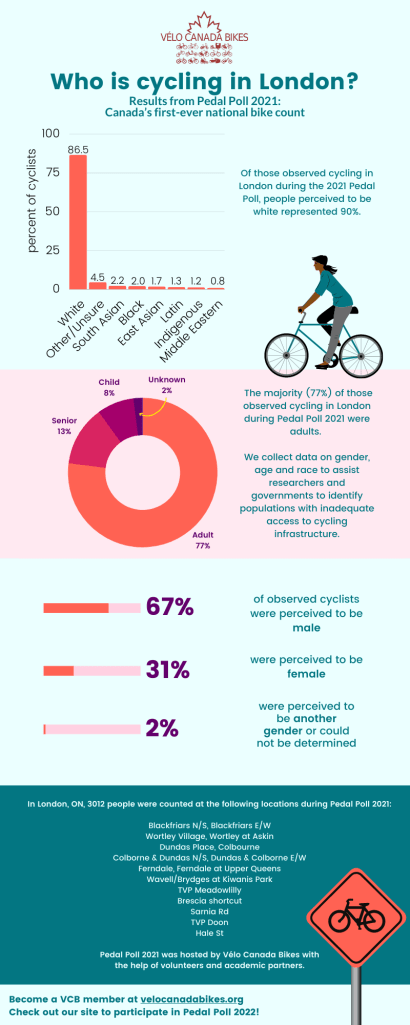
In the first year, it was a cyclist-count only. Riders were categorized by age, gender and ethnicity. London has participated since year one and the results from the 2021 poll were summarized in the graphic you see below.
Mobility Inequalities and Mode Share
The last Census (2021) shows that more than 30% of Canadians are non-white. In London, 23.7% of the population is racialized and 2.5% have Indigenous identity according to a City of London(2022) report. In the pedal poll survey 86.5% were identified as white.
Male and Female is close to a 50/50 split. In the pedal poll survey, the number of cyclists perceived as males were more than the double the number of women (67% male vs. 31% female).
Finally, adults represent close to 66% of the population both for Canada and London. In the Pedal Poll survey, adults were 77% of the observed cyclists.
Those results show that white, male and adults were overrepresented. That is the case for London and most other cities surveyed.
Implications for Mobility Justice
This data suggests that those demographics are more mobile than others when it comes to cycling. That is consistent with research showing that those same groups have higher mobility in general.
One of the implications for Mobility Justice is the understanding that an equitable mobility system is not only a matter of prioritizing one mode over the other but also understanding how intersectionality affects travel choice and how opportunities can be unevenly distributed even within a specific travel mode.
You can learn more about the 2021 Poll here. For more general results and in-depth analysis, there is a scientific article published in 2023.
In the following years, Pedal Poll shifted its methodology and started counting four travel modes (pedestrians, cyclists, personal motorized vehicles and oversized vehicles).
In another post, I will discuss the most recent poll with the new methodology.
 Luis Patricio
One thought on “Reflections from the first Pedal Poll in 2021”