Jibin Benoy lived in London Ontario. While riding his bike on Hamilton Road, he was hit by a person driving a car and died on September 18, 2022. He was an international student, a newlywed, and only 29 years old, with his whole life ahead of him.
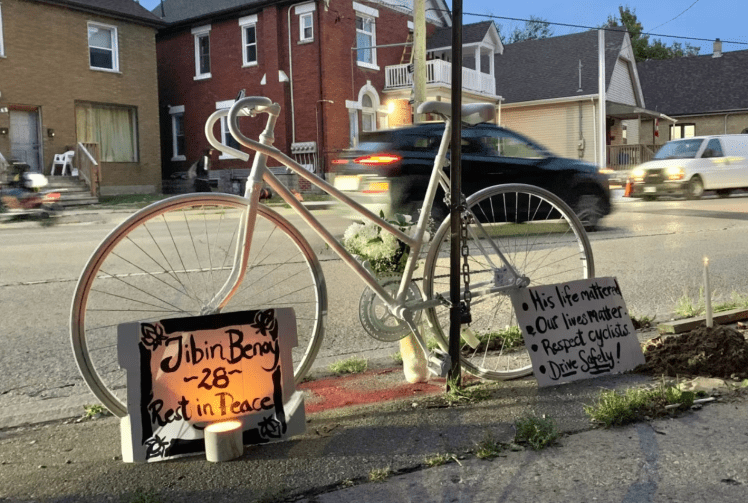
In the wake of his death, there was a memorial ride with a ghost bike, a protest at City Hall, a Vision Zero Campaign, countless meetings, Town Hall events, awareness sessions and even changes in the new strategic plan. Despite all those efforts, very little has actually changed on many of our roads since then.
It’s been almost a year and Hamilton Rd still is as dangerous as it was when Jibin was killed. Just like many other roads in London. As I write this, another Londoner just reported a near miss. Her son was hit by a person driving an SUV right in front of her. Fortunately this time there were “only” scrapes and bruises plus a traumatic experience for all involved.
As a reminder that mobility justice is relevant to all of us, despite how we choose to get around, I want to share here an adapted version of what I shared last year, a few days after Jibin’s death when a group of Londoners concerned with mobility justice organized a memorial ghost bike for him.
Another life was taken on the roads of London. Jibin Benoy was a 29 year-old Indian immigrant. I did not know him, and at the same time I did.
What I read in the news is that he was coming back from the restaurant where he worked. I read he was an engineer studying at Fanshawe and trying to bring his wife to Canada. That he was hit by a person driving a car who fled the scene. That he was taken to the hospital with serious injuries and died there. I read that Jibin was the kind of person who could not even hurt a fly.
I never met Jibin. I don’t know if any of you here have. And yet I know him. We know him! Many of us have experienced road violence before. Being verbally or physically attacked while cycling on the roads. And some of us have buried acquaintances, friends or family members.
There is a short Australian video where they tell a man that 213 people died from road violence and then ask him how many deaths are acceptable. He pauses for a moment and then says “70… maybe…” They show him what 70 people look like. Those people are his family and friends. His mother, his wife, kids, brothers. They ask him again. His answer becomes “ZERO” with much more conviction.
As people who use a bicycle to get around and try to make our city more inclusive, we know we have a lot in common. And we also have a lot in common with everyone else, whether we drive, walk, roll, take transit or paratransit. We are all a family, all human beings. And we have more in common than we think. My hope is that we can use our shared humanity to create a better place for everyone and to avoid something like that from happening again.
These deaths are preventable. We know the risks, we know they can happen, we know they will happen. Above all, we know and have the tools to prevent those deaths… and yet we don’t stop it from happening.
Some people said that Jibin should not have been on Hamilton road. But he was not doing anything wrong by riding his bike there. Our roads are public spaces where everybody and anybody riding a bicycle should be able to be! We are in Canada, supposedly a welcoming country, and we are denying so many of the basic human rights for a lot of us. Right to safety. Right to freedom of movement. For some of us, denying even the right to LIVE.
—
I can imagine the pain that his family and friends are experiencing. I lost quite a few loved ones myself. And I know that I want, we want, to prevent this from happening to anyone ever again. We are not asking for much. We are asking for everybody to have the right to safety, movement and life. Since a large number of Londoners, particularly equity-seeking groups (immigrants, low-income families, single parents among others) don’t have access to a car, ensuring those rights includes a network of protected bike lanes that are safe and convenient, and an efficient and reliable transit system. Roads designed in a way that it is physically impossible to speed above the limit. Lights timed for pedestrians and cyclists. A more fair distribution of resources such as space and capital with significant boosts to investments on infrastructure for people walking, wheeling, cycling, and bussing.
I hope we find the strength to build a city where our transportation choices are not a life (or death) sentence. Every infrastructure project should be evaluated with a mobility justice lens where they provide dignity to the most vulnerable among us.
 Luis Patricio
One thought on “Mobility Justice and Cycling”